
Many Americans might claim that they know where their money goes, but I think a great number would be shocked if they were presented with their figures. You’ve probably experienced it yourself, or heard it before: “Am I really spending that much on dining out? On my streaming services? I didn’t even know I had that subscription!” Most people don’t realize where their money goes until they actually look.
But, how do we let this happen? How do we pay so little attention to our money, the means by which so much of our livelihood is controlled? What makes it so difficult to track our spending, create a budget, and stick to it? The answer has much more to do with human psychology and culture than it does one’s ability. We live in a world that encourages us to spend, spend, and spend – buy the car, take the trip, add to cart, pick up the check, YOLO. Corporations spend billions to make us see life this way, and social media and influencers fan the flame. To do otherwise – to detach from this agenda, to deny oneself immediate gratification in the pursuit of a more secure future – requires a completely different relationship with money than what our world pushes on us.
If we want to fix this, we have to know ourselves, and we have to make a plan. How can we identify areas where we need to cut back if we don’t pay attention to where the money goes? Having knowledge – and more importantly, control – over your spending is the most important tool in building financial freedom.
So, what is a budget, really? There’s all kinds of definitions out there, but I like this simple one:
A budget is a plan for your money before you spend it.
It’s simple to say, but it is far harder to do. And, I might add, it’s not a perfect science. The good news is that a budget is not the end-all-be-all, and it’s OK for it to be wrong sometimes. The most important thing with budgeting is simply just to have one. Without it, there’s no way to know when life becomes out of balance. But, when done properly, you’re now in a position to cover your critical needs, enjoy your money today, and tuck enough away to enjoy yourself tomorrow.
Budgets can be hard – I personally break my budget every so often, sometimes by a lot. But we’re not alone; the same is true for businesses, charitable organizations, and government agencies. I feel like many Americans are afraid to create a budget because they’re afraid of failing to stick to it. Let me be clear: failing a budget does not mean you are bad with money. Life is unpredictable and irregular, and budgets require refinement; this is all part of the process.
In my personal finance journey, I have come across so many strategies and guidelines for budgeting. Most adhere to similar concepts, with slight variations among them in terms of ratios, prioritization, etc. My goal here is not to give you the absolute, most perfect budgeting strategy that will work flawlessly for everyone in all scenarios. My goal is to get you thinking, and to give you at least something you can get started with. If you want to go out after this, do more research, and find a system that works better for you, I am all for that.
Let’s break this down step by step. Note that in all my examples, I am assuming that our budget is set on a monthly basis.
Step 1: Figure Out Your Typical Income and Expenses
There is no sense in building a budget if I don’t first know where I am currently. To budget accurately, I need to have a good understanding of how much income I’m working with, and what I’m typically spending & saving. There are a few options to gather transactions:
- Apps – There are some really great budgeting apps out there that will integrate with your various financial accounts to pull in your past transactions automatically. What’s even better is that some apps will even automatically categorize the transactions into different budget categories for you, such as income, shopping, groceries, etc. This takes a lot of the work out of the process, and you can simply review to ensure the pre-selected categories are accurate. One thing I’d recommend if using Option 1 is that with all the time you save, spend some of it verifying that there aren’t missing transactions – sometimes the syncing process can be less than perfect and you wouldn’t want an incomplete picture before planning.
- Bank Statements – Another way to confirm your typical income and expenses would be to gather your recent bank statements, credit card statements, etc., and go through these line-by-line to determine total cash inflow vs. total cash outflow. This might take some time depending on how many accounts you regularly use, but you can be more certain that you aren’t missing any transactions.
- Go-Forward Approach – If neither of the above options are doable for you, then a third option would be to start tracking your income, expenses, and savings going forward. I’m not a fan of this option as I’d generally recommend that you need at least 2-3 months of data to establish a reliable baseline, which means you won’t be able to truly begin budgeting for several more months. The exception to this would be if you are someone who is just beginning to have income and real expenses for the very first time (e.g. a high school or college graduate who is newly entering the adult world). In that case, Option 3 is probably your only choice.
Regardless of the option you pick, here’s what we do:
- Take your collection of transactions (I always recommend at least 2-3 months’ worth if possible) and for each month, go through every transaction and sort everything you see into one of these four categories:
- Income
- Needs
- Wants
- Savings
There are certainly further breakdowns of these categories you could create, such as dividing up wants into sub-categories such as Dining, Entertainment, etc. Feel free to do so, but everything must roll up into one of the four main buckets listed above for this exercise.
- Don’t worry about getting your categorizations perfect – I’ve provided some definitions in a table down below, but if you’re not sure which category a transaction falls into, take your best guess. We’re just trying to get a baseline here. And also, don’t be overly concerned if one of your months has a large, irregular payday or expense that might skew the data. I generally recommend ignoring these, but if you choose to include them, the beauty of doing this for several months’ worth of data is that an irregularity or a miscategorization in one month will be smoothed out in the aggregate.
- Total up each of these categories per month, then average each category across the months. For example, if my income was $3,500 in April, $3,750 in May, and $3,100 in June, my average income is:
| Income (money in) | Expenses (money out) | Savings (money kept) |
|---|---|---|
| Income – Any time a reliable source of cash is coming into your possession. Think wages, tips, predictable investment income. If the month you’re categorizing has irregular income transactions, such as birthday checks or annual tax refunds, I’d recommend ignoring those. | Needs – non-negotiables. Be strict with this category. If I don’t spend this money, my safety, livelihood, and/or health are at risk. Think groceries, housing, insurance, minimum payments on loans, transportation. | Savings – you probably won’t have a “transaction” for this unless you have been moving money to a dedicated savings account. If you don’t have these transactions, then you will need to do some math – money-in for the month minus money-out for the month = savings. If this value is $0 right now, that’s OK. That is a real number, and we want a realistic picture of where we are right now. |
| Wants – anything you could’ve lived without. Think shopping, dining out, vacations, event tickets, getting nails done, etc. |
Step 2: Compare Against a Reliable Benchmark
Now that we know our average income, average expenses (split up into needs & wants), and average savings per month, we want to turn everything into a percentage of our income. For example, if my typical monthly income is $3,450, as in the example above, and my typical monthly needs cost $1,450, then my needs account for 42% of my income ($1,450 / $3,450 = 42%). Do the same thing for wants, and the same thing for savings.
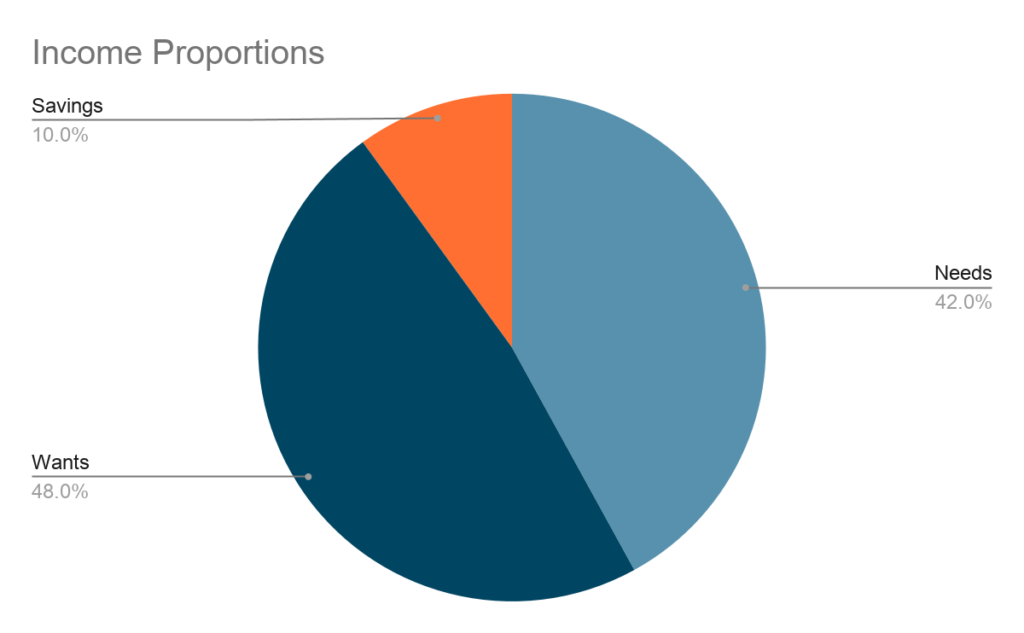
Now, you have a picture of the “pie” – you know where your income is going proportionally. Maybe 42% is going to needs, 48% is going to wants, and 10% is going to savings. Great – now what?
Well, this is where budgeting becomes subjective. As I said before, there are many opinions about what a healthy balance looks like, and it depends a lot on personal psychology. Some people are conservative, and want to target a very aggressive savings rate. Some people value life experiences, and want to find the cheapest possible housing so they can spend more on wants. Some people live in very high cost of living areas where an unusually high percentage must go to needs.
Here’s the deal – the framework that I’m going to suggest is one that is simple and extremely popular. To me, it feels like a healthy balance to life. After reading this, you may want to consider a different balance for yourself, or want to do some research to find other frameworks that maybe are more relatable for the area you live in, or your stage of life. That’s fine – my intention is to show you what a framework that is widely accepted as a healthy framework looks like. That way, if you find a different system that appeals to you, but strays far from what I present here, that should be enough to at least give you pause and make you wonder what the risks are.
The 50/30/20 Rule
The 50/30/20 rule is probably the most widely used budgeting strategy. It’s simple and perfect for both beginner and experienced budgeters.
50/30/20 says that, when considering your usual after-tax income, expenses, and savings (which we know for ourselves, having completed Step 1), 50% should go to needs, 30% should go to wants, and 20% should go to savings. That’s it. Super straightforward.
Now that we know our typical habits, how do we compare to the rule? Well, in my example, my personal ratios were 42/48/10 (42% needs, 48% wants, 10% savings). Compared to 50/30/20, I can see that I am slightly below target on needs, way above on wants, and only half of savings. Do the same for your numbers – how do you fare? And, what do we do with this?
The first, most important thing you can do is to reflect on how the relationships between your numbers make you feel. Do I feel anxious that I am undersaving compared to benchmarks? Do I feel wasteful overspending on wants compared to benchmarks? Does being under on needs make me feel like I could justify moving to a nicer part of town?
Your gut is a major tool for this next step, because now you need to decide what you want to do about your difference from the benchmark, if anything. Perhaps your numbers land pretty close to 50/30/20, and you don’t feel like any adjustments need to be made. Perhaps you are way under on wants spending, and way over on savings, and you’re comfortable with that and have no desire to spend more money. Perhaps you are way under on needs, and you feel that your frugality in that category justifies higher spending in wants.
If you do need or want to make adjustments to your lifestyle, know that some of these changes can be easy, and some can be hard to swallow. Below are just some example trains of thought to get your mind going, so I recognize that they may be oversimplified. And, keep in mind that these 3 categories are proportional to each other – you cannot change your behavior in one category without having to make adjustments in the others.
| If you are… | Needs | Wants | Savings |
| Over | – Bills need to be lowered – Shop around for better insurances quotes – Consider downsizing – Consider relocating – Consider roommates – Consider cheaper transportation costs | – Prepare more food/coffee at home – Limit clothing spend – Learn to say “no” to social invites | – Consider what you are depriving yourself of today – Consider what you are really saving for, and if you are actually over-saving for that goal. |
| Under | – Consider if anything is missing, such as quality healthcare, comfortable housing, reliable transportation, etc. | – Consider what expenses bring you joy or improve your life – Consider what relationships might improve with more spending (ex. dating, visiting (friends/family) | – Consider what future comfort and/or goals you will miss – Consider what risk you are exposing yourself to in unexpected emergencies. |
Take real time to reflect on these considerations. Then, let’s get budgeting.
Step 3: Make Your Budget and Track Against It
Now, you need to make your budget for the upcoming months. I might’ve just confused you – we just talked about 50/30/20, is 50/30/20 not our budget? Well, no. Not by default.
What do I mean? Well, if you compiled your personal numbers and found that 70% of your income goes to needs, then how in the world are you going to drop that by 20% overnight to achieve 50/30/20? Are you going to sell your house today and downsize? I really doubt that. When setting this first draft budget, we need to be realistic. If you set an unrealistic budget for yourself knowing where you are right now, you are setting yourself up to fall short. And when you fall short, you will be discouraged and much more likely to give up altogether.
So, what’s a more realistic budget?
Let’s say I found that, currently, my needs were 70%, wants 25%, and savings 5%. Then, maybe a realistic budget for me would be 65/20/15. This budget says that I reviewed my spending, and I believe I can find a slightly cheaper auto insurance quote this month to drop my needs by 5%. I can also make coffee at home this month instead of going to Starbucks, which can drop my wants by 5%. With that extra 10% between needs and wants, I can increase my savings.
This is a realistic budget; this is something that I know I can achieve because I know exactly what behaviors to change and what actions to take. Setting an unrealistic budget without a clear plan to achieve it is a recipe for failure. If you set a budget for yourself that is different from your current spending habits, and you can’t explain exactly what you will do in the upcoming month to achieve the change, then you need to rethink your budget.
Once you have your budget defined, you need to track your go-forward spending against it. Going into future months, you need to continue tracking all your transactions and sorting them into the same categories of income, needs, wants, and savings, just like we did in our initial exercise to understand our baseline.
By doing this, you can compare your actual performance against your budget and see whether your lifestyle changes are working. You also build better data on your habits each month, allowing you to make more informed decisions. And, if you started your budget somewhat conservatively to be able to make it realistically achievable for yourself, then you can consider becoming more aggressive in your budgeting once you start consistently meeting your goals.
Takeaways
If you are able to create a budget that resembles a healthy balance of your income between needs, wants, and savings, you are setting yourself up for financial success. You will be in a position very few of your peers are in, where you have the confidence in your basic needs being met, the comfort to spend money on the things you enjoy, and the assurance in your future self being set up to enjoy the same.
There are many things to consider when budgeting in practice. Life is unpredictable, and life does not operate on a monthly cycle. There will be good months, and there will be bad months, and like I said before, failing to meet a budget is not a sign of being bad with money. Failing to meet a budget is simply an opportunity to reflect on what happened. Was there a large, unplanned expense that month that threw the budget out the window? If so, then maybe there’s no cause for concern in your budget. Did you miss your savings goal for the month because your needs were increased by having to put down a deposit for a new apartment lease? Not necessarily a problem, but keep an eye on it to make sure you aren’t consistently undersaving. If you start to notice patterns where you are consistently failing to meet your budget month-over-month, then that is the time to review your budget once more, and decide if you need to reevaluate either the budget itself or if the lifestyle changes you thought would make you meet your budget aren’t working.
Recap – Action Plan
- Find a way to gather your transaction history, either through budgeting apps, bank statements, or tracking going forward.
- Categorize into Income, Needs, Wants, and Savings.
- Compare to 50/30/20, or a similar benchmark, and reflect on where you stand.
- Create a realistic budget for your first month, with an explainable plan for how you can change your behaviors to meet it.
- Track your actual transactions going forward, and compare performance against budget.
- Continuously review budget and evaluate opportunities for refinement
Next Things to Look Into
This article is meant to be a starter’s guide to budgeting, so for the overachievers, here are some related ideas to look into next if they interest you:
- Automate Savings
- You can’t be tempted to spend money if you never see it. Consider automatically transferring some of your paycheck into a dedicated savings account. That way, you’re forcing yourself to meet your savings goals before you ever have a chance to spend the money.
- How to Budget for Predictable, Large Expenses
- If you know you have a large, expected expense coming up, like a car or vacation, you can “budget” for this by dividing the expected purchase price by however many months there are until the transaction will happen. Then, each month, send that monthly amount into a savings account and treat the transfer transaction as a “Need” or “Want” for that month’s budget. This way, instead of your budget being blown up in the month that the transaction occurs, you can ignore it in the month the actual expense is realized because you’ve already accounted for it in your budget in all the preceding months.
- How to Budget for Unpredictable, Large Expenses
- If a large, unexpected expense occurs, it will break your budget for the month. The best way to avoid this is to keep a dedicated “emergency fund” of cash savings that is solely meant to be used for situations like this. This way, you can lean on the cash from the emergency fund to cover the expense, and since the cash was already moved into the emergency fund in prior months as part of your “savings” budget, you have already accounted for the large expense in previous months’ budgets, without having to know exactly what you were saving for.
- Physically Separate Your Accounts
- Not only is it a good idea to keep separate checking and savings accounts to completely divide your regular monthly spending money from money for long-term goals, but it can also be a great idea to further divide your savings accounts into separate accounts meant for different goals. For example, having a single savings account can get confusing when it’s filled with cash that is meant for many goals, such as for an upcoming vacation, as well as a car purchase, as well as this year’s Christmas gifts, as well as an emergency fund. If you have separate savings accounts for each individual purpose, it is much easier to mentally keep track of how much cash is allocated to each goal.
- The Order of Savings
- When you have many goals that you want to save for, it can be hard to keep track of how much of your monthly savings should go where. I like to think of your savings goals as a series of buckets waterfalling into each other, where the first bucket must be filled before the overflow trickles down to the next bucket, and so on. Decide what these “buckets” represent in your life. In mine, the first bucket is my emergency savings. None of my monthly savings will go towards any other purpose if I haven’t first met my expectation of what I should be putting into my emergency savings per month. Doing this, I find, actually forces myself to be diligent with my spending during the month because if I want to be able to save for fun things like trips, I absolutely have to meet or even exceed my savings goal for the month to be able to do so.